My son, Kal, is five. He ranks spicy peppers on the Scoville scale, will tell you without prompting that the Carolina Reaper sits at 2.2 million units, and is planning his cross-breeding strategy for inventing the spiciest pepper in the world. A few months ago, it was sharks: great or wingtip hammerhead, short or longfin makos, but also the esoteric: goblin, saw, epaulette. We went on weekly trips to the NY Aquarium. Before that it was space — planet sizes, distance from the sun, number of moons and surface temperatures.
He cycles through new interests every few months, and going deep is everything. He asks many questions I can’t answer, and loves to rank order. As a parent I love it because I become an expert with him, but most of the time I don’t know the answers, and the more long-tail the topic the fewer books exist that will satisfy him. We don’t want him on YouTube freely or chatting unsupervised with LLMs.
So I built him an app to let him go deep — Burrow.
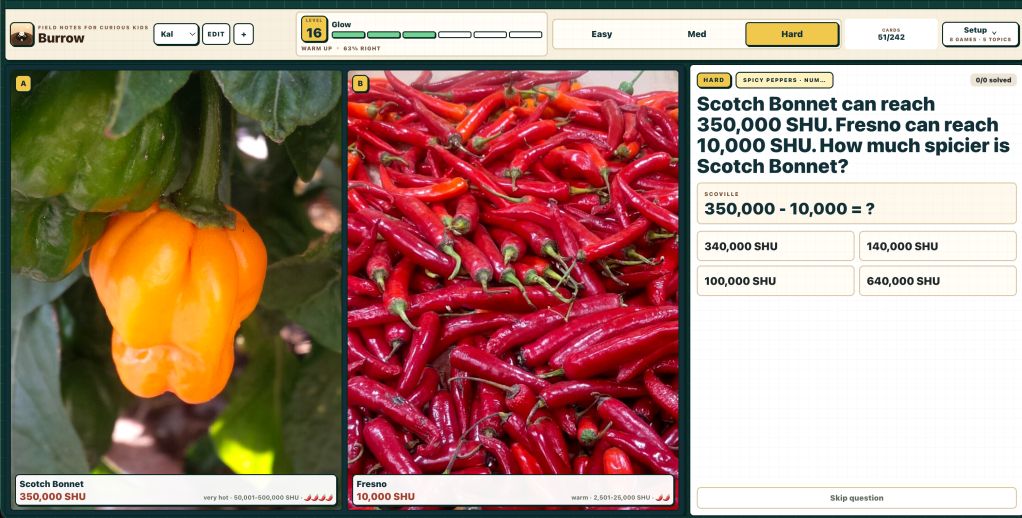
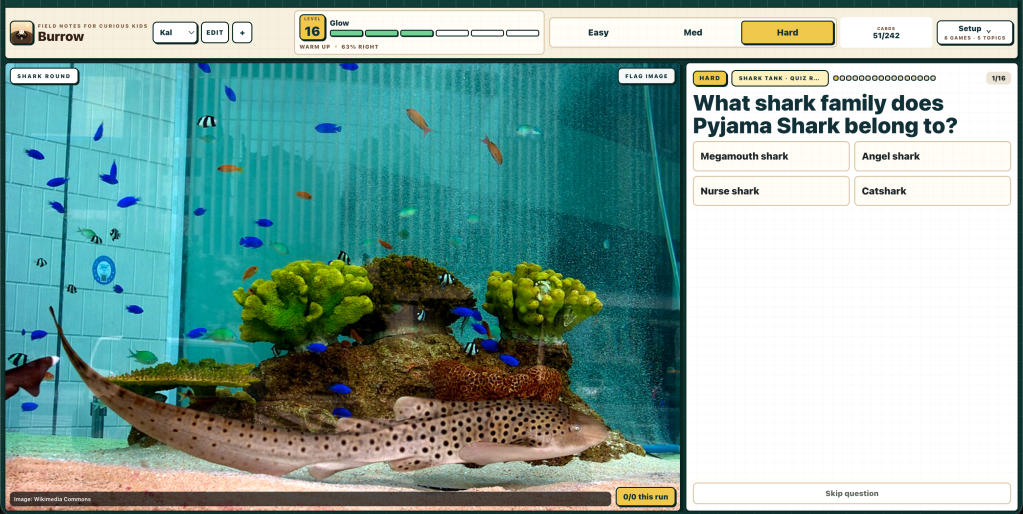
Each passion is a topic pack: Spicy Peppers, Sharks, Sky Scrapers, Space. There are multiple game types that teach reading, math, geography, and pattern recognition. Every card is a photograph with the relevant numbers (Scoville units, height, length, color), a few facts, and a link to the source. Whatever he’s currently into is also how he is building reading, math and reasoning skills. Kids learn better through topics they love over what they’re assigned. He’s not practicing reading, he’s reading about peppers, and the difference in energy evident. He’s been picking 15 minutes of Burrow over TV every morning and evening. The logic puzzles tire him out and the reading/math is sometimes too hard, but that’s by design.
I decided to not make a native IOS app because a progressive web app allowed me to iterate much faster. I built it with Codex, and it’s now over 20,000 lines of code that I’ve maybe read 20 of. Design and engineering took about a week, with maybe two or three full focused days of work – insanely fast.
It started as a single game (which pepper is hotter) and got boring almost immediately. So I added more game modes one at a time, then a math layer tuned to the right level of difficulty. When I added sharks, the images were inconsistent so I added image-quality checks to the QA step when adding new content. Top Trumps needed comparable stats across every pack to work properly, which meant cleaning up the data model so every game type would work natively with every content pack.
Adding a new content pack now takes about an hour. All I need to do is curate a few sources/links and Codex handles the rest. A year ago this would have been an entire weekend to source the content, write the metadata, and another weekend on QA.
My nephew Ari is ten and currently into fighter jets. So I made him a Jet pack with stats for top speed, range, payload, year introduced and added a “top trumps” game mode. He lives in London and was able to play it without me being next to him.
As a parent you know your kid deeply and you can build them something custom in the time it takes to plan a holiday. Whatever Kal gets into next, I’ll have it in the app by the time he wakes up in the morning.
Burrow lives at letthemburrow.com and the source is at github.com/amamujee/burrow. Request a pack for whatever your kid is into!


Leave a Reply