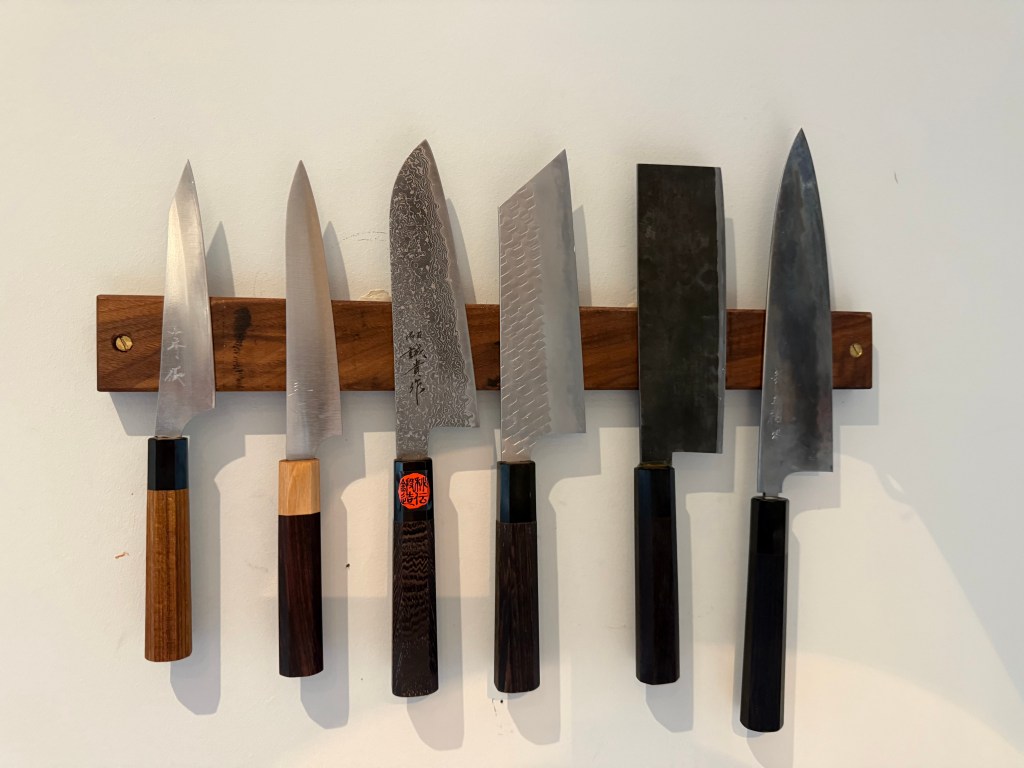
Every morning I cut fruit for my kids before school. Strawberries, mangoes, kiwis – whatever we have on hand. What was once mundane now feels special; a whole ritual. I inspect the knives on the magnetic strip and pick the right one for the job. The santoku for a large apple or pear, the petty for precise strawberry slices, the bunka for cantaloupes. I hone the blade on a ceramic rod, make my slices, wash the knife with the blade facing away from me (more on this later), dry it, and place it back on the strip. A few minutes of quiet focus before the chaos of getting two small children out the door.
The first Japanese knife I bought was a Masamoto KS Gyuto (White #2 Steel) in 2018 – an icon. I bought it because the internet and my cousin told me to. It sat in its sleeve for years, barely touched. I didn’t have the technique or the patience to deal with reactive steel. The knife deserved a better cook than me.
What got me going was buying a couple of cheaper, more forgiving stainless knives — a petty and a santoku — and actually using them every day while disappearing down the internet research rabbit hole. After a year, I ordered a Shigeki Tanaka Santoku, a Yu Kurosaki petty, and a Nigara Hamono Bunka all in R2/SG2 steel, but with different finishes.
The Only Guide Most People Need
Japanese knives are harder than Western knives. The steel is heat-treated to a higher Rockwell hardness (typically 60-65 HRC versus 54-58 for a German knife) which means the edge is thinner, sharper, and holds that sharpness much longer. The tradeoff is brittleness: you can’t rock the blade or torque the edge into a bone without risking a chip. You cut differently – push or pull cuts – and the result is cleaner, more precise, and more enjoyable.
This craft has been refined over centuries by craftsmen descended from former samurai sword makers. The forging, heat treatment, and grinding have been honed for longer than most Western knife companies have existed. When you hold a great Japanese knife, you can feel how much accumulated knowledge sits behind it.
If you want just one knife, make it a santoku. It’s shorter and flatter than a Western chef’s knife, usually 165–180mm, and it handles the basics extremely well. Get one in a powdered stainless steel like R2/SG2: hard enough to hold a wicked edge, and stainless enough so it does not need to be babied.
If you want two knives, get a gyuto and a petty. A gyuto is the Japanese chef’s knife, and 210mm is the sweet spot for most home cooks. A 150mm petty handles detail work, peeling, and anything awkward with a bigger blade. Start with stainless or stainless-clad: enough performance to feel the difference, without worrying about patina and rust while making dinner.
Get a soft cutting board. Hard surfaces like glass, marble, and bamboo will destroy an edge faster than anything. I keep a separate smaller wood board for fruits, a large teak wood board for vegetables (onions and garlic transfer smells), and a Hasegawa Pro PE for proteins.
Maintenance is minimal. Hone occasionally with a ceramic rod (not steel; ceramic is gentler on hard Japanese edges). Get them sharpened on whetstones every six months or so. I learned to sharpen myself, and now I do it for my family — my mom, my in-laws. 15 minutes per knife and it makes an immediate difference in their kitchens. A small thing that makes their lives a little better.
With a couple of good, no-fuss stainless knives you could stop here and be better equipped than 99% of home cooks.
I did not stop here.
Down the Rabbit Hole
Once you start, you realize there’s an entire world to be explored. Different steels behave differently. Carbon steels like Shirogami (White Steel) and Aogami (Blue Steel) both take incredibly keen edges but are reactive, meaning they patina and need more care. White steel is the purest, sharpest, and easiest to sharpen. Blue steel adds tungsten for better edge retention at the cost of being harder to sharpen. Powdered steels like R2/SG2 give you stainless convenience at high hardness. Each one cuts differently, feels different on the board, sharpens differently.
Then there are blade shapes beyond the first three: nakiris for vegetables, bunkas for angular precision, sujihikis for slicing proteins. Each one purpose-built for a specific cut. And then you discover the different blacksmiths and sharpeners. This is where it gets dangerous.
Japanese knife-makers don’t sell commodities; they forge heirlooms. Many of the most respected smiths are individual craftspeople or tiny family workshops forging a handful of knives at a time. Some have multi-year waitlists. Some sell out within minutes of a drop. Some knives are numbered. You don’t just buy a knife from these makers, you hunt for one.
What I’ve Learned from Collecting
I keep a Notion database tracking every knife I own: steel type, blade length, handle material, finish, maker, grind, and price. My collection spans about a dozen knives across different finishes (damascus, tsuchime, kurouchi, migaki), handle woods, carbon and stainless cores, short petties and long gyutos, lasers and workhorses.
Owning this range has taught me things that reading about knives never could – this hobby is tactile after all.
The reactive carbon steel knives get used far less than the stainless-clad ones. Patina management, drying immediately after every cut, worrying about acidic food on the blade adds friction to daily cooking. Stainless-clad (like my Takedas) is the sweet spot for someone who actually cooks every day.
The longer gyutos (240mm and above) also get used less than I expected. I don’t prep restaurant-scale quantities. For home cooking, 210mm or shorter covers almost everything.
And grind matters more than steel when it comes to food release. I’ve owned expensive knives in premium steels that couldn’t make it through an onion without wedging, and modest knives in common steels that glide through everything. The steel makes the initial cut, but the grind dictates how smoothly the rest of the blade follows.
My current favorite is a Konosuke BY gyuto that I bought directly from the manufacturer. It’s a White #1 steel, which means it’s reactive. It develops a patina over time, darkening where it meets food, changing with every meal. The knife feels alive. Every detail reflects care: the choil is immaculate, the finish is exceptional, and it arrived with a personalized keychain and the best packaging of any knife I’ve bought. The best knife isn’t the most coveted or the hardest to find. It’s the one that disappears in your hand and lets you focus on the food.
Going Deeper
The Real Chef Knives Wiki is the single best resource I’ve found, exhaustive on steels, grinds, heat treatment, and makers from every region of Japan. YouTube has excellent knife reviewers. Reddit’s r/TrueChefKnives is active and welcoming to beginners. The Kitchen Knife Forums (KKF) is where the serious collectors trade. I also keep The Knifenerd Guide to Japanese Knives on my coffee table. Beautiful book, equal parts reference and appreciation for the craft.
For buying: Bernal Cutlery, Carbon Knife Co, Tosho Knife Arts, Chefsknivestogo, Burrfection and Korin in NYC have all been great. I’ve also imported directly from manufacturers in Japan a few times. It takes longer, sometimes involves a waitlist, but there’s something satisfying about the knife arriving from the same place it was forged.
What I’m Adding Next
The wishlist is short now, which probably means I’m getting close to done (or that’s what I tell myself). A Takada No Hamono (new moon) stainless 210mm gyuto or santoku. Boutique, refined, and a laser. And a Jiro Nakagawa. Each one numbered, forged by a single smith, essentially a piece of functional art. Jiro’s knives are among the hardest to source in the Japanese knife world. I’m happy to be patient.
One Last Thing
Japanese knives are very sharp. Always clean with the blade facing away from you. Always cut on a stable surface.
And learn from my mistake: I cut myself badly enough that a former army medic at urgent care told me most people don’t actually need to come in for cuts, but I definitely did. My finger got glued and butterfly-stitched, took six weeks to heal, and still doesn’t feel quite right a year later.
You do not need a collection. A single santoku and a good board are enough to change how cooking feels.
 Aadil Mamujee
Leave a comment